Find Business Emails: The Definitive Guide for 2026
February 4, 2026
Direct B2B outreach is more vital than ever as businesses compete in a fast-evolving digital landscape. In 2026, the ability to find business emails is crucial for cutting through noise, driving sales, and forming strategic partnerships. Yet, many face hurdles such as outdated databases, stricter GDPR rules, and increased gatekeeping.
Accurate contact information enables targeted outreach, higher conversion rates, and more meaningful networking. This guide delivers a step-by-step approach to find business emails efficiently and compliantly.
Explore the evolution of email discovery, legal essentials, top tools, actionable strategies, advanced tactics, and best practices for successful outreach.
Understanding the Landscape of Business Email Discovery in 2026
Navigating how to find business emails in 2026 requires understanding the rapid changes shaping the B2B outreach landscape. With evolving privacy laws, smarter technology, and more discerning recipients, successful email discovery demands both strategic thinking and up-to-date knowledge.
The Evolution of Email Finding: 2020–2026
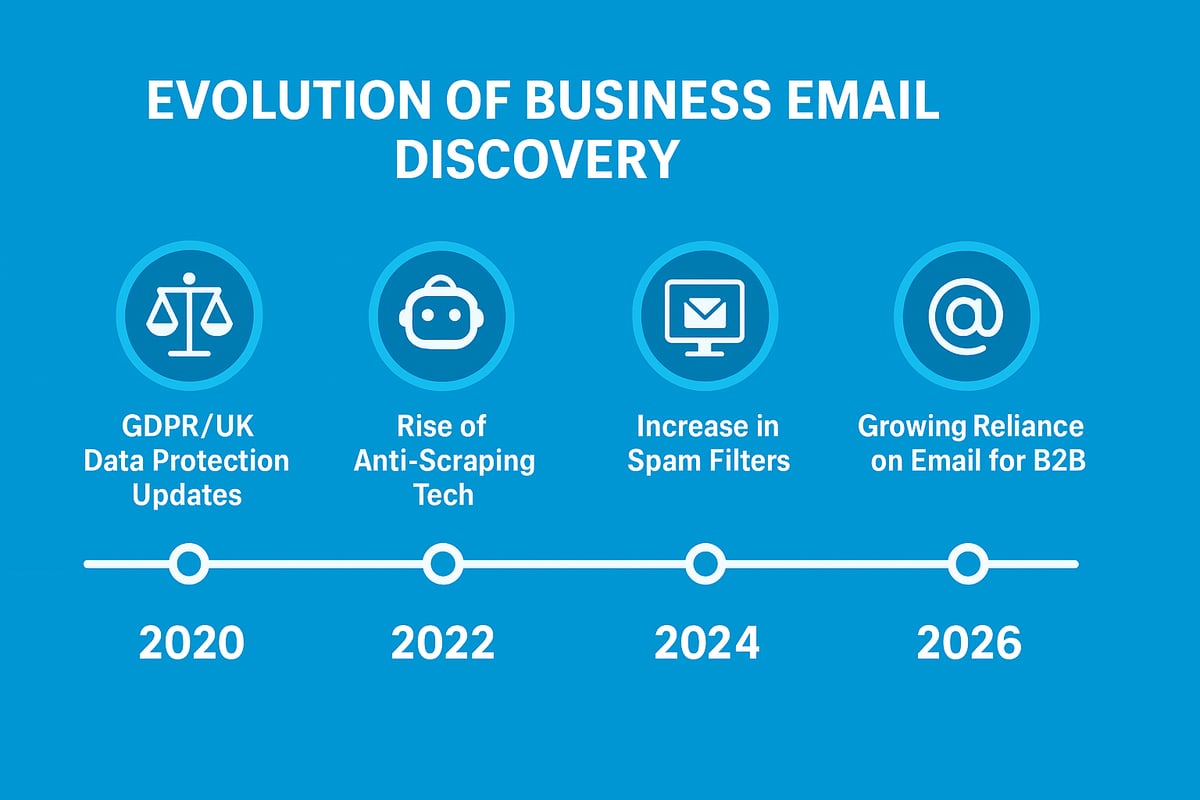
Over the past six years, the drive to find business emails has intensified alongside the growth of B2B sales and outbound outreach. Data privacy regulations like GDPR and the UK Data Protection Act have become stricter, placing greater emphasis on responsible data handling.
At the same time, spam filters have grown more sophisticated, and anti-scraping technologies are now common on platforms such as LinkedIn. For example, LinkedIn has significantly limited access to contact data, making it harder to extract emails using automated tools.
These shifts mean that businesses must now blend technology with ethical practices to maintain compliance and achieve results.
Why Finding Business Emails Matters More Than Ever
Email remains the leading B2B communication channel, with 81 percent of businesses relying on it for outreach, according to Statista. The effectiveness of social media direct messages and cold calling continues to decline, as decision-makers become more selective in how they engage.
Personalised outreach, built on accurate data, drives higher conversion rates and opens doors for sales, partnerships, and networking. For a deeper dive into strategies for sourcing and using email addresses effectively, see this email address for email marketing resource.
In 2026, being able to find business emails reliably is a competitive advantage, enabling your team to reach the right people at the right time.
Common Challenges in 2026
The task to find business emails has grown more complex due to several challenges. There has been a surge in fake or disposable business email accounts, making validation essential.
Company websites have fortified their anti-scraping defences, limiting access to contact details. Automation tools are powerful, but over-reliance can lead to impersonal outreach, which risks alienating prospects.
To succeed, businesses must strike a balance between automation for efficiency and a human touch for authenticity.
The Role of Data Compliance and Ethics
Compliance is now central to any effort to find business emails. GDPR, PECR, and similar global laws have evolved, with 2026 bringing tighter enforcement and higher penalties for breaches.
Companies face significant risks, including fines and blacklisting, if they fail to secure consent or misuse data. Adopting opt-in strategies and transparent data handling builds trust and protects your brand.
Ethical email discovery is not just about ticking boxes, it is about fostering lasting, compliant relationships with your audience.
Legal and Ethical Considerations When Finding Business Emails
Understanding the legal and ethical landscape is crucial when you find business emails in 2026. Regulations have evolved, and businesses face greater scrutiny regarding how they collect and use email data. Staying informed ensures your outreach efforts remain compliant, effective, and trustworthy.
Current Laws and Regulations Affecting Email Discovery
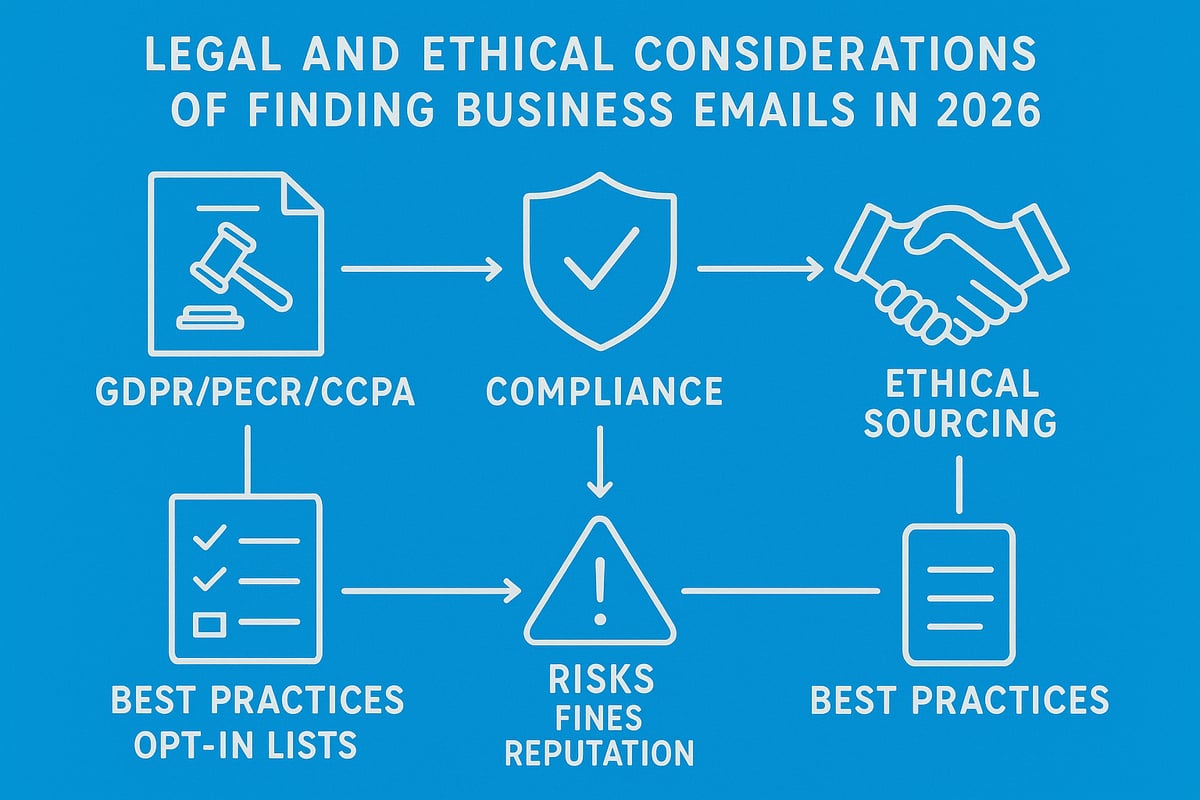
When you find business emails, you must navigate a complex web of regulations. The General Data Protection Regulation (GDPR), the UK’s Privacy and Electronic Communications Regulations (PECR), and the US’s California Consumer Privacy Act (CCPA) all set strict standards for handling contact data.
In 2025 and 2026, updates to these laws have increased transparency requirements and expanded the definition of personal data. GDPR now covers more types of identifiers, and PECR demands clearer consent for B2B outreach. For those seeking a detailed breakdown on compliance, the GDPR Compliance in B2B Email Marketing guide provides up-to-date insights.
To remain compliant when you find business emails, always ensure you have a lawful basis for processing, keep records of consent, and provide recipients with clear opt-out options.
Ethical Approaches to Email Sourcing
Ethical considerations go beyond ticking legal boxes. When you find business emails, it is essential to respect privacy and data rights at every step. Always identify yourself clearly in initial outreach, and avoid misleading tactics or hidden data collection.
Building trust starts from the very first contact. Be transparent about why you are reaching out and what value you offer. This approach not only improves response rates but also helps you stand out in a crowded inbox.
Respecting preferences is equally important. If someone opts out, ensure their details are removed promptly from all future outreach lists. Ethical sourcing builds long-term business relationships and protects your reputation.
Risks and Consequences of Unethical Practices
Cutting corners when you find business emails can have serious consequences. Companies have faced hefty fines for breaches of GDPR and PECR, sometimes reaching millions of pounds. In addition to legal penalties, reputational harm can be severe, with news of non-compliance spreading rapidly.
Domain blacklisting is another risk. If recipients mark your emails as spam, your sender reputation suffers, and future messages may be blocked. This can cripple outreach campaigns and impact the entire organisation.
Spam complaints also trigger investigations, leading to further scrutiny of your data practices. Maintaining ethical standards is not just about avoiding fines, but also about safeguarding your brand’s credibility and effectiveness.
Best Practices for Staying Compliant
To find business emails responsibly, prioritise compliance at every stage. Use opt-in lists rather than relying solely on scraped data. Data minimisation is key: only collect what you genuinely need for outreach.
Store data securely and restrict access to authorised team members. Conduct regular compliance reviews and audits to ensure your processes remain up to date with changing laws.
A simple compliance checklist might include:
| Best Practice | Description |
|---|---|
| Opt-in Lists | Collect emails with explicit consent |
| Data Minimisation | Only keep essential data |
| Secure Storage | Use encrypted, access-controlled tools |
| Regular Audits | Review and update compliance regularly |
Following these steps will help you find business emails effectively, while reducing legal and ethical risks.
The Best Tools and Methods to Find Business Emails in 2026
Today, finding reliable ways to find business emails is essential for success in B2B outreach. The landscape has evolved rapidly, offering a mix of advanced platforms, browser integrations, manual research, and verification tools. Let's explore the most effective strategies and solutions for 2026.
Overview of Modern Email Finding Tools
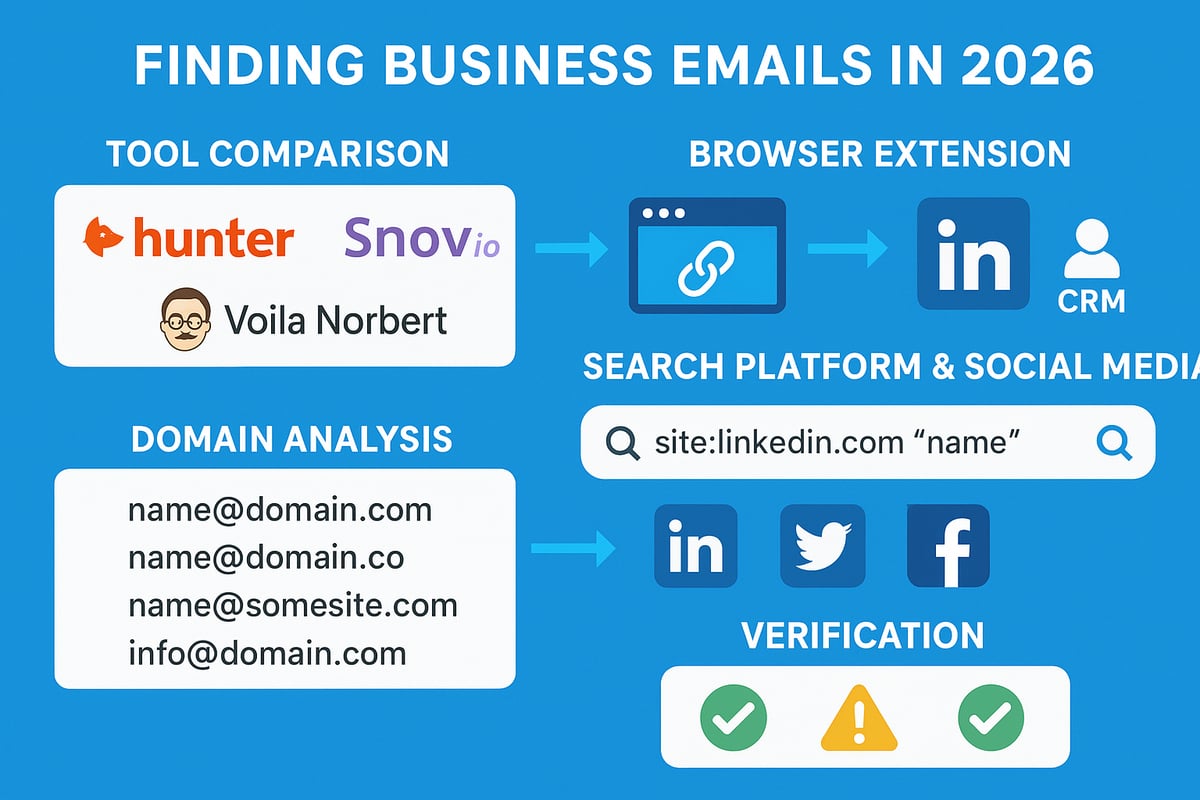
To find business emails efficiently, modern platforms have evolved with AI-powered features and flexible pricing. Leading tools such as Hunter.io, Snov.io, and Voila Norbert dominate the market, each offering distinct strengths.
| Tool | AI Features | Free Tier | Paid Plans |
|---|---|---|---|
| Hunter.io | Pattern prediction | Yes | Credits-based |
| Snov.io | Bulk search, AI | Yes | Monthly/annual |
| Voila Norbert | Email guessing | Yes | Pay-as-you-go |
These platforms leverage machine learning to enhance accuracy when you find business emails. Free versions typically allow limited searches, while paid plans unlock bulk discovery and integrations. AI has notably reduced error rates, making these tools indispensable for modern sales teams.
Browser Extensions and Integrations
Browser extensions play a pivotal role in helping professionals find business emails directly from LinkedIn or company websites. Chrome and Edge plugins, such as those from Seamless.AI, overlay contact data while you browse profiles.
Key features to look for include:
- One-click email extraction
- Automatic syncing with CRM platforms
- Real-time data enrichment
Integrations with outreach tools enable seamless workflow, so you can find business emails and launch campaigns without manual data entry. This approach increases efficiency and ensures data accuracy, especially for large-scale prospecting.
Manual Techniques for Email Discovery
Sometimes, automated tools fall short, making manual strategies vital to find business emails that are hard to locate. Advanced Google search operators, like site:company.com "@company.com", can surface emails hidden in public documents or press releases.
Example code block:
"@company.com" + "firstname lastname" site:company.com
Checking About Us or press pages often uncovers direct contacts. Analysing public email patterns can help you reconstruct likely addresses. For more in-depth methods, see this guide on how to find owner of email, which offers practical steps for verifying contact details.
Leveraging LinkedIn and Social Media
LinkedIn remains a goldmine for indirect clues to find business emails. Although direct addresses are less visible, profile information and activity can reveal naming conventions. Twitter bios and professional Facebook pages sometimes list work emails or provide hints.
Use these steps:
- Examine LinkedIn for role and domain alignment
- Search Twitter for public email mentions
- Cross-reference social handles with company websites
By piecing together these clues, you can often deduce the correct format and find business emails that are not readily available elsewhere.
Company Website and Domain Analysis
Analysing company domains is a reliable way to find business emails using pattern recognition. Most organisations follow predictable formats such as [email protected] or [email protected].
Tools like Email Permutator+ can generate all possible combinations based on known patterns. Validation tools then help confirm which addresses are active.
This method is especially effective when combined with public team pages and press releases, allowing you to systematically find business emails for specific teams or executives.
Email Verification and Deliverability Checks
Once you find business emails, verifying their legitimacy is crucial to protect your sender reputation. Real-time verification platforms such as NeverBounce, ZeroBounce, and MailTester assess deliverability and flag risky or catch-all domains.
Key steps include:
- Uploading email lists for batch validation
- Removing bounced or invalid addresses
- Monitoring sender score after campaigns
Accurate verification ensures your outreach reaches intended recipients and helps maintain positive engagement rates, which is essential for any successful strategy to find business emails in 2026.
Step-by-Step Guide: How to Find Business Emails in 2026
Finding accurate business emails in 2026 requires a systematic approach. With evolving privacy laws and sophisticated anti-scraping measures, businesses must combine smart research, the right technology, and compliance-focused outreach. This step-by-step guide will help you efficiently and ethically find business emails, maximise your outreach success, and maintain your sender reputation.
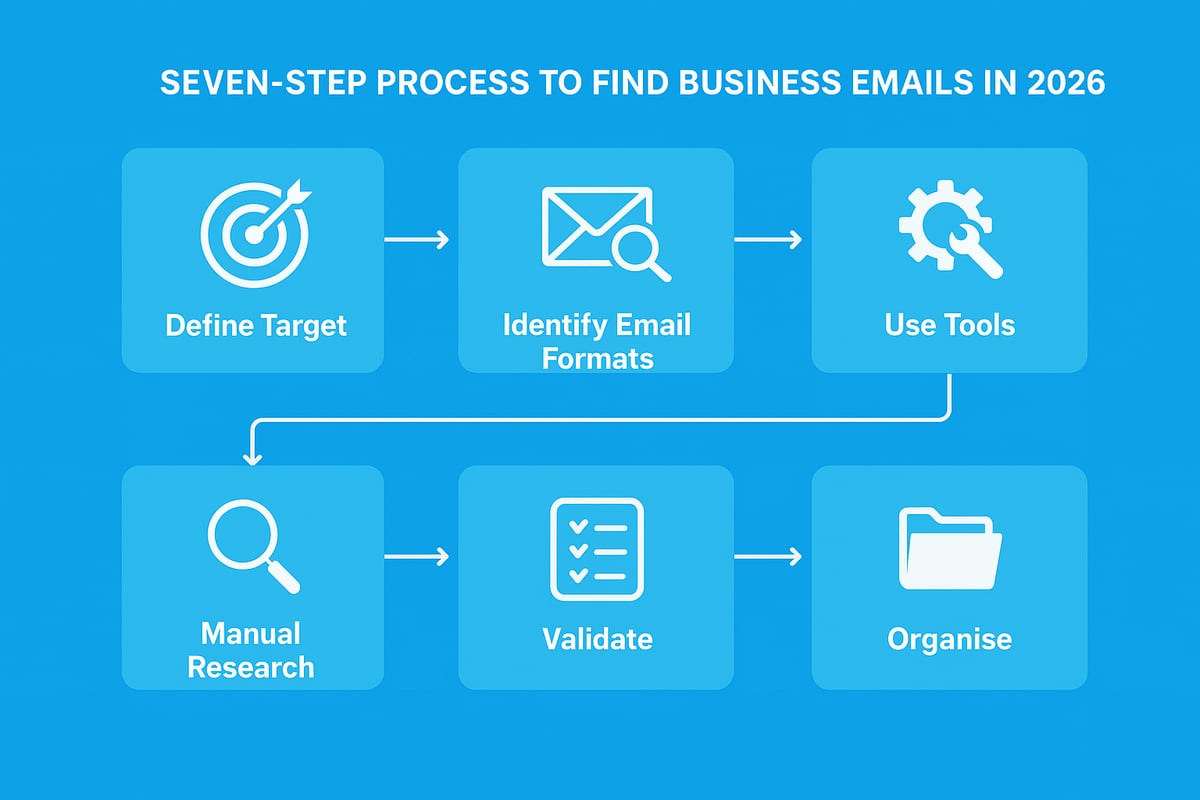
Step 1: Define Your Target and Research Companies
Start by clarifying exactly who you need to contact. To find business emails effectively, identify decision-makers or key personnel within your target companies. Use LinkedIn filters to pinpoint roles, departments, and regions. Crunchbase and company directories can reveal company size, sector, and recent activity.
For example, if you aim to connect with UK SaaS founders, create a shortlist of relevant businesses and their leadership. Document names, titles, and company details in a spreadsheet. This foundation ensures the rest of your find business emails process is focused and data-driven.
Step 2: Identify Likely Email Formats
Once you have your target list, research the standard email format used by each company. Most organisations use predictable structures such as [email protected] or [email protected]. To find business emails with higher accuracy, leverage Email Format Finder tools or check the company’s own website for clues.
Here is a quick reference table for common UK business email formats:
| Format | Example |
|---|---|
| firstname.lastname@ | [email protected] |
| firstinitial.lastname@ | [email protected] |
| firstname@ | [email protected] |
Knowing the likely structure streamlines your ability to find business emails efficiently.
Step 3: Use Email Finder Tools for Initial Search
Now it is time to use dedicated platforms to automate your search. Enter the names and domains you have gathered into reputable tools such as Hunter.io, Snov.io, or Voila Norbert. These platforms match names against known patterns and databases to help you find business emails at scale.
Compare results across multiple tools to spot inconsistencies or duplicates. Export your findings and filter out generic addresses like info@ or sales@. Assess the accuracy rates of each tool by sampling a few emails for manual verification, ensuring you only keep high-quality leads.
Step 4: Supplement with Manual Research
Sometimes, automated tools miss valuable contacts. To find business emails others overlook, dig deeper using manual research. Search for press releases, event speaker lists, or webinar registrations where professional emails may be published. Use advanced Google operators such as site:company.co.uk "@company.co.uk" to surface public mentions.
Look for clues in social media posts or downloadable PDF documents. Reverse engineering from these public sources helps you uncover hidden contacts and adds depth to your list. Always record the source of each email for compliance purposes.
Step 5: Validate and Verify Emails
Before sending any outreach, it is critical to confirm that your emails are deliverable. Use verification platforms like NeverBounce, ZeroBounce, or MailTester to check for invalid or risky addresses. These tools quickly flag catch-all domains and reduce the chance of bounces.
By validating every address, you protect your sender reputation and maximise deliverability. This step is essential to find business emails that will actually reach your intended recipients, rather than being lost to spam folders or hard bounces.
Step 6: Organise and Segment Your Email List
Proper organisation is the backbone of successful outreach. Use spreadsheets or a CRM to categorise each contact by source, role, and engagement potential. Tagging emails helps you personalise messaging and track which methods helped you find business emails most effectively.
Schedule regular reviews to update information and remove outdated entries. Fresh, segmented lists improve both deliverability and response rates, ensuring your efforts continue to yield results as your campaigns progress.
Step 7: Prepare for Outreach—Personalisation and Compliance
Your final step is preparing for outreach while prioritising compliance. Personalise your emails with tailored subject lines and content, referencing the recipient’s role or recent company news. Always include a clear opt-out option and log consent where applicable.
For more details on crafting compliant, effective messages, see this emails to companies guide. By following these best practices, you will find business emails convert at a higher rate and maintain a strong sender reputation.
Advanced Tactics and Strategies for Finding Hard-to-Reach Business Emails
Unlocking access to elusive business contacts can feel like searching for a needle in a haystack. In this section, we explore innovative tactics that empower you to find business emails even when conventional methods fall short. Mastering these strategies can give your outreach a genuine edge in 2026.
Using Data Enrichment Services and APIs
Data enrichment platforms have revolutionised how professionals find business emails. These services pull from multiple data sources to provide up-to-date contact details, often through seamless API integrations. By connecting tools like Clearbit or FullContact to your CRM, you can automate the search for verified addresses directly within your workflow.
To get started, select a reputable enrichment service, input the target company or individual, and let the platform retrieve relevant information. Many APIs offer real-time results, reducing manual research time and improving accuracy. This approach is especially effective when you need to scale efforts and find business emails for large prospect lists.
Cross-Referencing Multiple Data Sources
When a single source comes up empty, cross-referencing can reveal hidden connections. Start by combining information from LinkedIn profiles, company filings, press releases, and news articles. Each data point helps build a more complete contact profile.
For example, WHOIS records often list administrative emails for domain ownership, while public company documents may mention key personnel. By piecing together clues from various records, you can find business emails that are not easily accessible via standard tools. This method requires patience but often yields results that automated platforms miss.
Leveraging AI and Machine Learning
Artificial intelligence has taken the ability to find business emails to the next level. AI-powered tools analyse vast datasets to detect email patterns and predict likely addresses with impressive accuracy. These platforms use machine learning algorithms trained on millions of examples, continuously improving their match rates.
For instance, recent reports highlight that AI-driven solutions have boosted email identification success rates by 20% compared to manual methods. By employing predictive models, you can uncover addresses that traditional guesswork would overlook. Integrating AI into your workflow streamlines the process and helps you stay ahead in a competitive landscape.
Community and Crowdsourced Databases
Sometimes, the best way to find business emails is by tapping into the collective knowledge of online communities. Platforms like GitHub, AngelList, and industry-specific forums often feature public spreadsheets or discussion threads where professionals share contact details.
While these resources can be invaluable, it is important to assess the reliability and privacy of the data. Always verify addresses before outreach to avoid deliverability issues. Crowdsourced databases are particularly useful for niche industries or startups where official directories are scarce, giving you another way to find business emails that are otherwise hidden.
Bypassing Gatekeepers Legally and Ethically
Even the most advanced tools encounter human barriers. Building genuine relationships with executive assistants or connecting at events can unlock access to decision-makers. Attend webinars, join networking groups, and engage thoughtfully on professional platforms to foster trust before making your request.
When you find business emails through these channels, always prioritise ethical practices and data security. For more on keeping your outreach compliant and secure, see this guide on secure email for small business. Respect boundaries, avoid aggressive tactics, and ensure your contact methods align with modern privacy standards. This approach not only improves results but also safeguards your reputation.
Best Practices for Successful Business Email Outreach in 2026
Effective outreach is the final, crucial step after you find business emails. To maximise impact in 2026, it is essential to blend personalisation, deliverability, database hygiene, and precise measurement.
Personalisation and Relevance in Email Outreach
Personalisation remains the most effective way to stand out when you find business emails. Tailoring subject lines and content to the recipient’s role, industry, or recent activity demonstrates genuine interest.
Dynamic fields within your outreach tools help you reference company names, achievements, or mutual connections. Segmenting your audience by buyer persona or industry further increases relevance. According to B2B Email Marketing Statistics 2025, personalised campaigns consistently outperform generic messaging, with open and reply rates significantly higher.
In 2026, recipients expect value from the first touchpoint. Personalisation not only improves engagement but also reduces the risk of your emails being ignored or marked as spam.
Optimising Deliverability and Avoiding Spam Filters
When you find business emails, ensuring your messages actually reach inboxes is vital. Technical setup is the foundation for deliverability. Use the following authentication protocols:
| Protocol | Purpose |
|---|---|
| SPF | Confirms sender identity |
| DKIM | Validates message integrity |
| DMARC | Prevents spoofing |
Begin with a sender warm-up routine to build reputation. Avoid using spam trigger words or excessive formatting. Maintain a consistent sending schedule and monitor feedback loops for any issues.
Regularly check your deliverability rates and adjust your approach if you notice declines. High deliverability rates protect your sender reputation and ensure your efforts to find business emails yield real results.
Managing and Updating Your Email Database
After you find business emails, ongoing database management is essential for campaign success. Regular list cleaning prevents you from sending to inactive or bounced addresses.
Use email verification tools to keep your data fresh. Remove hard bounces and opt-outs promptly. Leverage automation to schedule periodic database hygiene without manual effort.
Segment your list by engagement, source, and role. This approach ensures you always reach the right contacts and maintain compliance. A well-managed database enhances the effectiveness of every outreach campaign.
Measuring Outreach Success and ROI
To justify the resources you invest to find business emails, tracking key metrics is critical. Measure open rates, response rates, and conversions for each campaign.
A/B test subject lines, messaging, and calls to action to identify what resonates best. Industry benchmarks, such as those reported in Cold Email Response Rates in 2026, show that multichannel strategies and refined targeting are essential as response rates evolve.
Regular analysis allows you to refine your approach, allocate resources efficiently, and achieve higher ROI. By measuring results, you ensure that every effort to find business emails delivers tangible business value.
Frequently Asked Questions About Finding Business Emails
Is it legal to find and use business emails for outreach in the UK?
Yes, it is legal to find business emails for B2B outreach in the UK, provided you comply with GDPR and the Privacy and Electronic Communications Regulations (PECR). These laws distinguish between B2B and B2C communications, with B2B outreach generally requiring less strict consent, but you must always identify yourself clearly and offer a way to opt out.
When you find business emails, ensure your outreach is relevant to the recipient’s role and interests. This reduces the risk of complaints and helps maintain compliance. Keep records of how you sourced each email address, and always provide an easy method for recipients to unsubscribe or request data removal.
For further context on the importance of email in B2B, see these Email Marketing Statistics 2025, which highlight email’s continued dominance as a trusted channel.
What are the safest tools for finding business emails in 2026?
To find business emails securely, use reputable and compliant platforms. Leading tools in 2026 include Hunter.io, Snov.io, Voila Norbert, and Seamless.AI. These platforms prioritise data security, offer transparent privacy policies, and regularly update their databases for accuracy.
When choosing a tool, look for features such as GDPR compliance, encrypted data handling, and robust verification systems. Avoid platforms that rely solely on scraping or provide unverified data, as these can lead to compliance risks.
A good practice is to trial several tools, assess their accuracy, and ensure they integrate with your CRM. Keeping security top of mind will protect your sender reputation and ensure your find business emails strategy remains effective.
How do I avoid my emails being marked as spam?
To ensure your find business emails outreach does not land in spam, follow technical and content best practices. Start with authenticating your sending domain using SPF, DKIM, and DMARC records. Warm up new sending addresses gradually to build a positive sender reputation.
Personalise every message, avoid spam trigger words, and offer clear value in your content. Always include a visible unsubscribe link. Monitor your sender reputation and adjust your strategy based on feedback and delivery reports.
Regularly verify your email lists to remove invalid addresses. This not only improves deliverability but also protects your domain from blacklisting and supports long-term outreach success.