The SaaS Email Marketing Playbook Guide for 2026 Success
January 12, 2026
In 2026, email marketing stands as the heartbeat of SaaS growth, driving engagement and powering customer journeys in an ever-evolving digital landscape. As new technologies and privacy regulations reshape the field, mastering the saas email marketing playbook becomes essential for every forward-thinking SaaS marketer.
This guide walks you through each critical step, from building high-quality lists to creating campaigns that convert, automating workflows, ensuring deliverability, and analysing performance for ongoing improvement.
You will discover the latest strategies, actionable frameworks, and proven tactics tailored for SaaS success. Ready to unlock maximum ROI and future-proof your email efforts? Dive in, implement these insights, and lead your SaaS brand to sustainable growth.
The Evolving Landscape of SaaS Email Marketing in 2026
The SaaS industry is entering a transformative era, with email marketing at its core. As we explore the evolving landscape, the saas email marketing playbook becomes an essential tool for navigating the rapid changes in technology, regulation, and customer expectations.
Key Trends Shaping SaaS Email Marketing
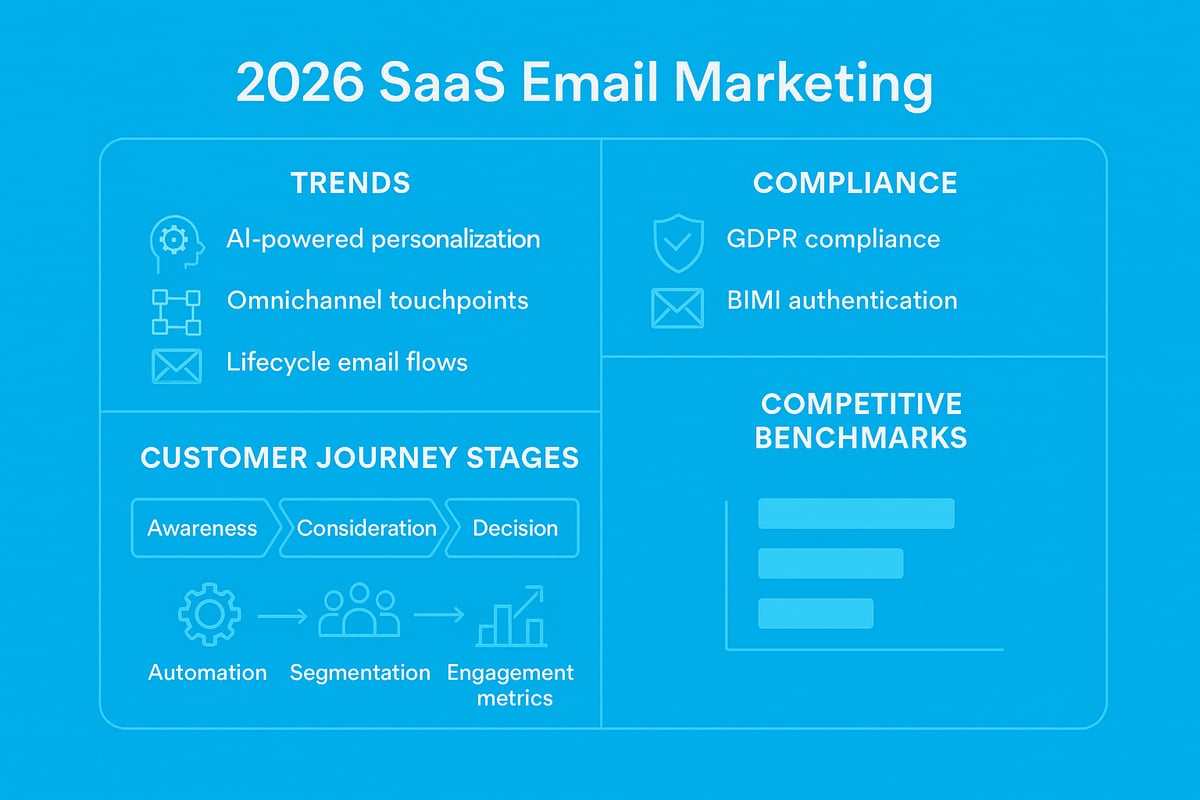
In 2026, several trends are reshaping the saas email marketing playbook. AI-driven personalisation and predictive analytics are empowering brands to deliver tailored messages that anticipate user needs. Hyper-segmentation and dynamic content allow marketers to reach the right person with the right offer at the perfect time.
Integration with omnichannel SaaS customer journeys ensures a seamless experience across email, in-app, and other digital channels. Privacy regulations, such as GDPR and ePrivacy, are driving stricter consent practices and data management. The rise of BIMI and advanced authentication protocols is improving deliverability and brand trust.
For example, SaaS brands leveraging AI have reported engagement increases of up to 40 percent. According to industry reports, 78 percent of SaaS companies increased their email marketing spend in 2025. For more insights on the latest trends, see SaaS marketing trends shaping 2026.
Why Email Remains the SaaS Growth Engine
Despite new channels, email remains the backbone of the saas email marketing playbook. It provides a direct, owned communication channel, unlike paid or organic social media, giving SaaS brands control over their customer relationships.
The returns are substantial: email delivers an average of £40 for every £1 spent. Email is vital for onboarding, retention, upsells, and renewals. One SaaS company reduced churn by 20 percent through onboarding drip emails. A recent survey found that 90 percent of SaaS buyers check their email daily.
These factors reinforce why email is a foundational growth engine in SaaS.
Regulatory and Deliverability Challenges in 2026
The regulatory landscape is more complex than ever. Stricter spam filters and AI-based email policing are common. New consent frameworks, including double opt-in requirements, are mandatory for compliance.
Sender reputation and DMARC authentication are now critical. Poor list hygiene can quickly lead to blacklisting, as seen when a SaaS platform suffered deliverability issues due to non-compliant practices. Data shows that one in six SaaS emails lands in spam without proper compliance.
The saas email marketing playbook must now include robust compliance and deliverability strategies.
The SaaS Customer Lifecycle and Email Touchpoints
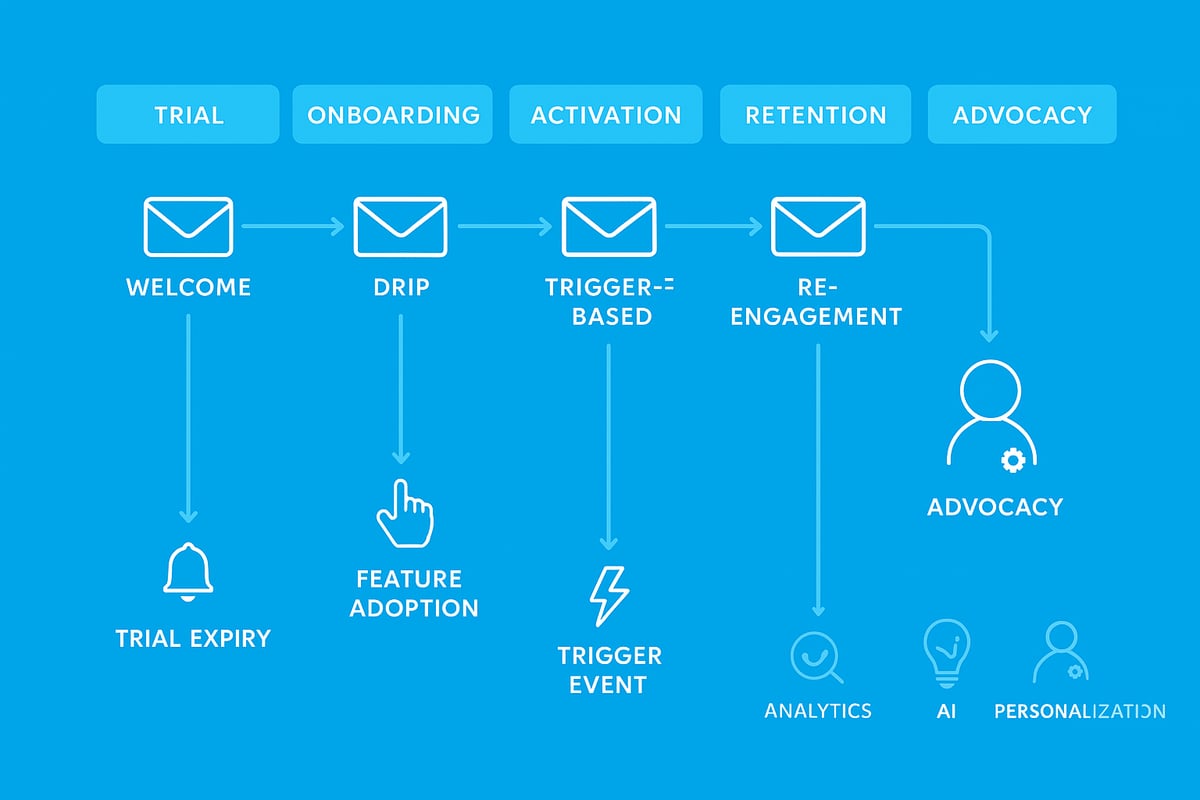
Mapping email campaigns to the SaaS customer lifecycle is fundamental to the saas email marketing playbook. Each stage—trial, onboarding, activation, retention, and advocacy—demands tailored messaging.
Behaviour-triggered emails are key at every step, from automated re-engagement for lapsed users to activation reminders. Lifecycle emails consistently outperform generic blasts, achieving three times higher engagement.
Successful SaaS brands use these targeted touchpoints to guide users toward long-term loyalty.
Competitive Benchmarking: What Top SaaS Brands Are Doing
Top SaaS email marketers set the standard for frequency and content strategy. They use micro-segmentation and real-time data triggers to boost relevance.
Here is how leading brands compare:
| Metric | Top SaaS Brands | Industry Average |
|---|---|---|
| Open Rate | 35%+ | 20-25% |
| Click-Through Rate | 10%+ | 2-5% |
| Churn Rate | <5% | 10% |
In 2025, these benchmarks highlighted the effectiveness of the saas email marketing playbook. Consistent analysis and adaptation drive ongoing success.
Step 1: Building and Segmenting a High-Quality SaaS Email List
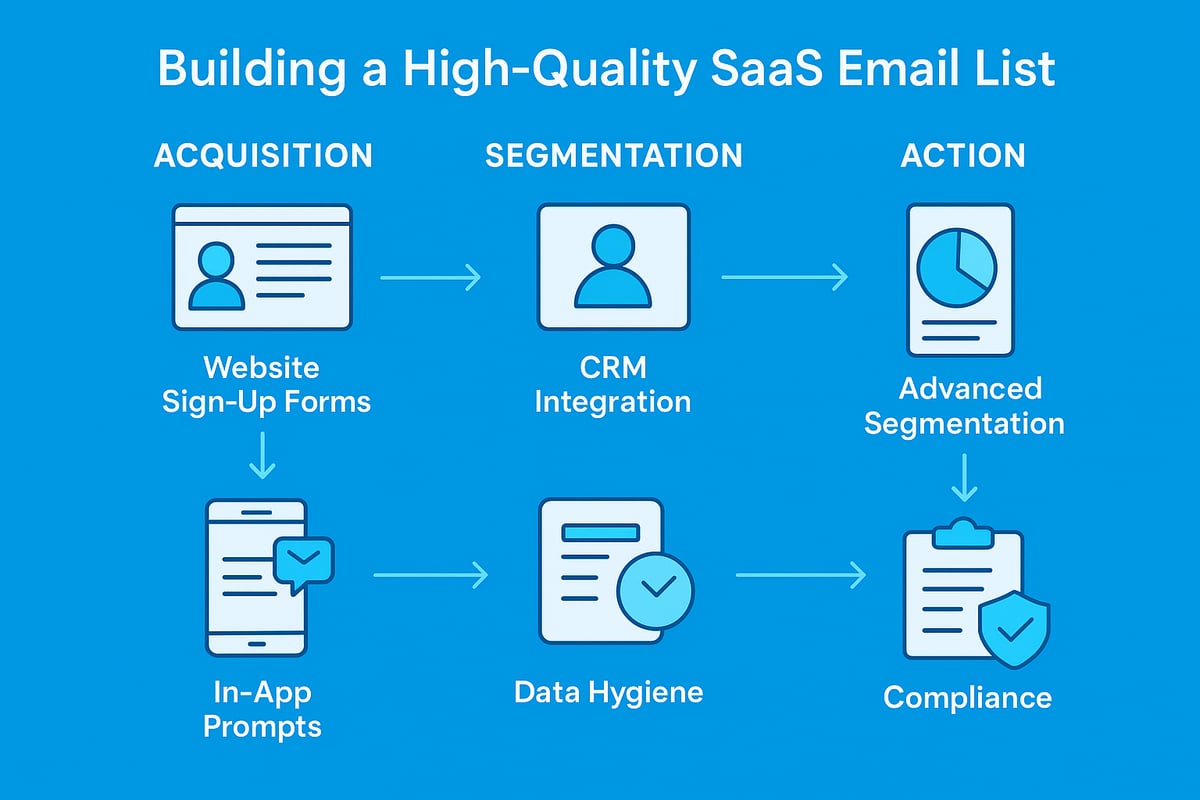
Building a robust email list is the cornerstone of the saas email marketing playbook. In today's SaaS landscape, a high-quality, segmented list is your passport to higher engagement, conversions, and long-term growth. Each step, from acquisition to compliance, shapes your ability to deliver relevant, timely communications that drive results.
Proven List Building Strategies for SaaS
Successful list building in the saas email marketing playbook relies on attracting qualified leads through multiple channels. Leverage these strategies:
- Website sign-up forms with compelling calls-to-action
- Lead magnets such as eBooks, demos, or free trials
- In-app prompts targeting active users
- Co-marketing partnerships and integrations with other SaaS tools
For instance, running a focused webinar series can grow your list by 300%. According to industry data, 70% of SaaS signups occur directly on landing pages. For actionable steps tailored to SaaS brands, see this Building an Email List for SaaS resource.
Advanced Segmentation for Personalisation
Segmentation is the engine of personalisation in the saas email marketing playbook. Move beyond static lists by segmenting users based on:
- Lifecycle stage (trial, active, churn risk)
- Product usage and engagement level
- Company size and industry
- Behavioural triggers (feature adoption, inactivity)
Dynamic lists automatically update as user data changes, outpacing static segments. For example, segmented onboarding emails can boost activation rates by 25%. Hyper-segmentation ensures your messages resonate and drive higher engagement.
Data Hygiene and Compliance Best Practices
Clean data and regulatory compliance are non-negotiable in the saas email marketing playbook. Implement these best practices:
- Use double opt-in to confirm user intent
- Maintain up-to-date consent management records
- Regularly remove bounced or inactive emails
- Provide automated unsubscribe and preference centres
A clean list achieves up to 99% deliverability. Consistent data hygiene not only improves inbox placement but also protects your sender reputation and aligns with evolving privacy regulations.
Integrating Email with SaaS CRM and Product Data
Integration is a core pillar of the saas email marketing playbook. Sync your email platform with CRM and product analytics to unlock real-time targeting. This enables:
- Triggered emails based on product usage data
- Contextual upsell or cross-sell messages
- Automated workflows tailored to user actions
For example, a CRM integration allows you to send usage-based upsell emails when a customer hits key milestones. This real-time approach ensures your communications are always timely and relevant.
Avoiding Common SaaS List-Building Mistakes
The saas email marketing playbook also highlights pitfalls to avoid. Common mistakes include:
- Buying email lists, risking blacklisting and poor engagement
- Ignoring GDPR or ePrivacy rules, leading to fines
- Over-segmenting, which can reduce communication frequency and impact
A real-world case saw a SaaS platform fined for non-compliance due to improper consent practices. Stay vigilant and regularly review your approach to keep your list healthy and compliant.
Step 2: Crafting High-Converting SaaS Email Campaigns
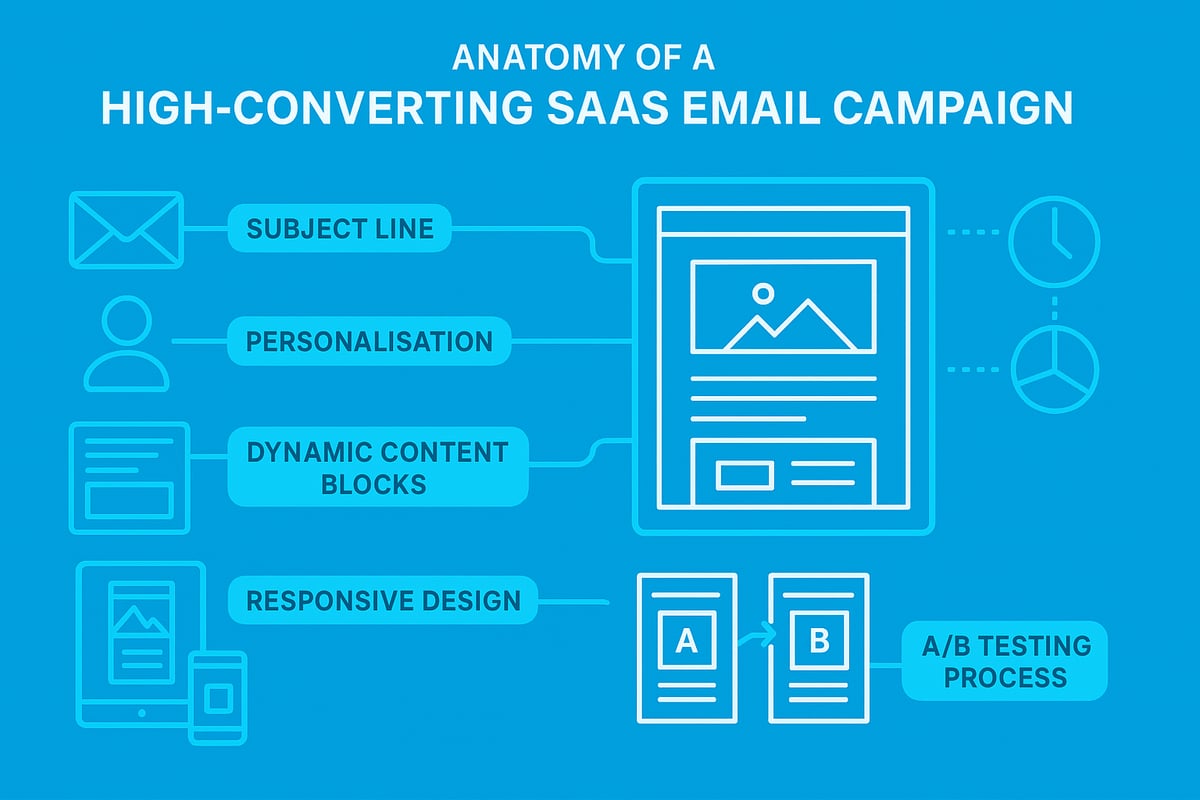
Building high-converting campaigns is the heart of the saas email marketing playbook. Success depends on combining targeted messaging with persuasive design, personalisation, and data-driven optimisation. Let us explore the five pillars of effective SaaS email campaigns.
Writing SaaS-Specific Email Copy That Converts
Compelling copy is the foundation of the saas email marketing playbook. Effective subject lines focus on clear benefits, such as "Unlock Advanced Features in Your Free Trial," rather than vague promises.
Personalisation should extend beyond using the recipient's name, incorporating details like company, role, or relevant use case. For example, "See how your team at Acme Ltd. can automate reporting." Strong calls-to-action (CTAs) are value-driven, urging readers to "Start Your 14-Day Trial" or "Book a Personalised Demo."
A/B testing subject lines can lead to significant improvements. One SaaS company saw a 32 percent increase in opens by comparing "Get Started in Minutes" versus "Your Onboarding Checklist Awaits." These details ensure every message in the saas email marketing playbook is engineered for conversion.
Designing Responsive and Accessible Email Templates
Design plays a crucial role in the saas email marketing playbook. Templates must be mobile-first, as most SaaS users check emails on smartphones and tablets. Use readable fonts, logical structure, and clear alt text for all images to ensure accessibility for every subscriber.
Brand consistency is vital. Include logos, colour schemes, and trust signals like customer testimonials or security badges. Responsive layouts adjust seamlessly to any device, preventing formatting issues that can harm engagement.
Accessibility is not just about compliance, it is about inclusivity. By prioritising these elements, the saas email marketing playbook ensures your campaigns reach and resonate with all users.
Personalisation and Dynamic Content at Scale
Personalisation is at the core of the saas email marketing playbook. Advanced platforms enable dynamic content blocks, allowing you to tailor messaging based on user behaviour, company size, or lifecycle stage. For example, onboarding emails can display personalised usage statistics or tips relevant to each user's journey.
Role-based messaging ensures that decision-makers see upgrade offers, while end-users receive feature tutorials. Dynamic content adapts in real time, delivering the right message to the right person.
To master this, consider strategies outlined in the SaaS Email Marketing Agency Guide, which details expert approaches for scalable, personalised campaigns that drive engagement.
Timing, Frequency, and Cadence Optimisation
Optimising send times and frequency is a vital part of the saas email marketing playbook. Research shows that mid-week emails, particularly on Tuesdays and Thursdays, yield higher engagement for SaaS audiences.
Balancing nurture content with sales messaging prevents subscriber fatigue. A weekly cadence often doubles engagement compared to sporadic sends, but always test to find your ideal rhythm.
Map your cadence to the customer journey, using behaviour triggers to send timely messages during onboarding or renewal periods. This strategic approach ensures every touchpoint in the saas email marketing playbook is both relevant and effective.
A/B Testing and Iteration for Maximum Impact
Continuous testing is the secret weapon in the saas email marketing playbook. Test subject lines, CTAs, and templates to uncover what resonates with your audience. Analyse results and implement learnings in the next campaign cycle.
For example, iterative testing helped one SaaS firm boost trial conversions by 50 percent. Document each test, noting metrics like open rates, click-throughs, and conversions for every variant.
This data-driven mindset ensures ongoing improvement. With regular iteration, the saas email marketing playbook evolves to meet changing user preferences and market trends.
Step 3: Automation, Drip Campaigns, and Lifecycle Nurturing
Automation is the true engine behind scalable SaaS email marketing. In this part of the saas email marketing playbook, we will break down how to design automated workflows, create effective drip campaigns, and nurture users throughout the entire SaaS lifecycle.
Essential SaaS Email Automations for 2026
Automation is at the heart of the saas email marketing playbook. In 2026, SaaS brands rely on several core automations to drive user engagement and retention.
Key automations include:
- Welcome and onboarding series to introduce new users.
- Trial expiration reminders that prompt upgrades before access ends.
- Product update and feature announcement flows to keep users informed.
- Renewal and payment notifications to reduce involuntary churn.
For example, automated renewal emails have helped SaaS platforms decrease churn by 15%. Each automation is mapped to a specific lifecycle stage, ensuring users receive the right information at the right time.
Building Effective Drip Campaigns for SaaS
A powerful drip campaign is a foundational element in the saas email marketing playbook. Drip sequences are mapped directly to the user journey, supporting activation, adoption, and retention.
Effective SaaS drip campaigns include:
- Educational content to help users master the product.
- Engagement emails that encourage feature exploration.
- Timely upsell prompts for relevant add-ons or upgrades.
For instance, a SaaS company implemented a targeted onboarding drip and saw a 40% increase in activation rates. Drip content is carefully planned to deliver value at every step, reducing the risk of users dropping off before they experience product benefits.
Behavioural Triggers and Event-Based Messaging
Behavioural triggers are a cornerstone of the saas email marketing playbook. These automations respond to user actions in real time, making every message relevant.
Common triggers include:
- In-app actions like completing a setup or using a new feature.
- Periods of inactivity, prompting re-engagement.
- Milestone achievements, such as hitting a usage threshold.
Triggered emails outperform generic campaigns by generating up to four times higher revenue. Real-time triggers ensure users feel seen and supported, whether they are power users or need a nudge to return.
Measuring and Optimising Automated Workflows
Measurement is vital throughout the saas email marketing playbook. Every automated workflow should be tracked and optimised to maximise impact.
Key metrics to monitor:
- Open and click rates for engagement.
- Activation, conversion, and churn rates for business impact.
- Workflow completion times to identify bottlenecks.
For example, by analysing onboarding sequences, a SaaS platform reduced time-to-value by 30%. Regularly reviewing analytics allows teams to refine content, adjust timing, and improve user outcomes.
Scaling Automation Without Losing the Human Touch
Scaling automation in the saas email marketing playbook requires balancing efficiency with personalisation. Users expect contextually relevant messages that feel human, not robotic.
Best practices include:
- Using personalised sender names and conversational tone.
- Segmenting users for targeted, role-specific content.
- Leveraging AI-driven personalisation to tailor experiences at scale. For deeper insights, see how AI-driven personalization in SaaS marketing can transform engagement.
A 2025 survey found that customers prefer automated emails that mimic authentic human interaction. By blending automation with personal touches, SaaS brands can nurture loyalty and drive lasting growth.
Step 4: Deliverability, Compliance, and SaaS-Specific Challenges
Deliverability and compliance are the backbone of the saas email marketing playbook. Without a strategic approach to technical setup, privacy, and hygiene, even the most creative campaigns risk being lost to spam folders or regulatory issues. Let us explore the critical elements you must master to ensure your SaaS messages reach and resonate with your audience.
Ensuring Inbox Placement in 2026
Inbox placement is a foundation of the saas email marketing playbook. In 2026, authentication protocols such as SPF, DKIM, DMARC, and BIMI are non-negotiable. These verify your domain and brand identity, reducing the chance of your emails being flagged as spam. Monitoring sender reputation is equally important. SaaS brands that proactively check blacklists and maintain consistent sending patterns see notable improvements in deliverability.
For example, one SaaS company increased inbox placement by 20% after adopting BIMI and regular authentication reviews. Keeping up to date with evolving deliverability standards is essential. For more practical guidance, review Email Deliverability Best Practices to address common technical pitfalls and solutions.
Navigating Global Privacy Regulations
Compliance is a core pillar of the saas email marketing playbook. In 2026, global privacy laws such as GDPR, ePrivacy, and CCPA demand strict consent management. You must collect, store, and prove user consent at every step. Double opt-in processes are now standard, as are detailed records of permission.
SaaS brands face increasing scrutiny from regulators. A recent case involved a company quickly adapting its consent flows to comply with updated EU privacy directives. The key is to stay agile, audit your processes, and prioritise transparency, building long-term trust with your audience.
List Hygiene, Bounce Management, and Spam Avoidance
Maintaining list hygiene is indispensable in the saas email marketing playbook. Regularly remove inactive or bounced addresses to protect your sender reputation. Implement re-permission campaigns to re-engage dormant users and keep your list fresh.
Clean lists are proven to deliver results. Data shows that SaaS companies with robust hygiene practices achieve up to 99% inbox placement. Also, automate unsubscribe and preference management to ensure compliance and reduce spam complaints. Consistent hygiene directly increases engagement and deliverability.
SaaS-Specific Deliverability Pitfalls and Solutions
There are unique challenges in the saas email marketing playbook that require strategic attention. High-volume sending can trigger spam filters, especially when using shared IPs. To mitigate risk, separate transactional and marketing emails, and monitor IP reputation closely.
For example, one SaaS platform resolved an IP block by moving to a dedicated ESP and segmenting their sends. Being proactive with monitoring and clear separation of email types will protect your deliverability. Addressing these SaaS-specific pitfalls is vital for maintaining reliable communication and supporting growth.
Step 5: Analytics, Optimisation, and Scaling SaaS Email Success
Unlocking the full potential of the saas email marketing playbook requires a sharp focus on analytics, continual optimisation, and scalable operations. As SaaS brands compete in a crowded 2026 market, precise measurement and agile improvement are essential for lasting growth.
Key Metrics for SaaS Email Campaigns
Measuring the right metrics is the backbone of the saas email marketing playbook. Focus on open rates, click-through rates, conversions, activations, churn, and customer lifetime value. These indicators reveal how well your campaigns engage and convert users.
Cohort analysis is especially valuable for tracking onboarding and retention performance over time. According to Email marketing statistics for 2026, leading SaaS brands achieve 10 percent or higher upgrade rates through targeted email initiatives. Benchmark your results regularly to spot gaps and opportunities for improvement.
Advanced Attribution and ROI Measurement
Understanding which emails drive revenue is essential in the saas email marketing playbook. Advanced attribution models connect each campaign to product usage and revenue, giving a clear picture of what delivers results.
Multi-touch attribution traces user journeys across touchpoints, ensuring credit is assigned accurately. For practical guidance, review Email Marketing ROI Insights to learn how SaaS companies link email activity to annual recurring revenue growth. With robust analytics, you can confidently allocate budget for maximum impact.
Continuous Optimisation Strategies
Continuous improvement is at the heart of the saas email marketing playbook. Run ongoing A B tests on subject lines, content, and segmentation. Refresh email copy and visuals quarterly to keep messaging relevant.
Leverage user feedback from NPS surveys and direct responses to refine workflows. According to industry data, 60 percent of SaaS marketers update their email flows every quarter. This commitment to iteration ensures your campaigns stay competitive and audience focused.
Scaling Email Operations for Growth
Scaling your efforts is crucial for the saas email marketing playbook to deliver exponential results. Invest in automation tools and workflow management platforms to streamline processes and reduce manual tasks.
Define clear team roles and document processes for consistency. Many SaaS startups have doubled their email output by implementing workflow automation. As you scale, maintain quality and personalisation to foster lasting customer relationships and drive sustainable growth.
Future-Proofing Your SaaS Email Marketing Strategy for 2026 and Beyond
Staying ahead in SaaS email marketing requires constant innovation. As 2026 approaches, the saas email marketing playbook must evolve to keep pace with rapid technological change and shifting customer expectations. Let us explore how forward-thinking SaaS teams can prepare for tomorrow, ensuring their email strategies remain relevant, effective, and resilient.
Embracing AI, Machine Learning, and Predictive Analytics
The next evolution in the saas email marketing playbook is driven by artificial intelligence and machine learning. AI now powers content generation, send-time optimisation, and hyper-personalised segmentation, helping SaaS companies predict user churn and spot upsell opportunities with remarkable accuracy. For example, brands leveraging personalized marketing offer generation using AI have slashed churn rates by up to 35 percent and delivered messaging that resonates on an individual level.
Predictive analytics also allows teams to anticipate customer needs, sending the right message at the right time. By embedding these technologies into the saas email marketing playbook, SaaS marketers can automate personalisation at scale while maintaining a human touch.
Integrating Email with the Full SaaS Martech Stack
A unified martech stack is essential for executing the saas email marketing playbook across every customer touchpoint. Integrating email with CRM, product analytics, and customer support platforms creates a single source of truth for user data. This integration empowers SaaS teams to deliver contextual, data-driven messages and react in real-time to user behaviour.
Data shows that integrated martech stacks drive 25 percent higher engagement. By making the saas email marketing playbook part of a wider ecosystem, brands can offer seamless, holistic experiences that boost loyalty and lifetime value.
Preparing for Emerging Channels and Technologies
The future of the saas email marketing playbook is multi-channel. SaaS brands are combining email with in-app messages, SMS, push notifications, and chat to reach users wherever they are. Emerging technologies like AMP for Email enable interactive experiences, letting users take action directly within the inbox.
Interactive emails have been shown to increase SaaS engagement by 50 percent. As new channels emerge, integrating them into the saas email marketing playbook ensures messaging remains relevant and adapts to changing user preferences.
Building a Culture of Experimentation and Agility
To keep the saas email marketing playbook future-proof, SaaS teams must foster a mindset of continuous learning and rapid iteration. This means encouraging innovation, testing new strategies, and quickly pivoting when user behaviour shifts. For instance, when a SaaS company noticed a drop in engagement, they adapted their approach and saw immediate improvements.
Staying ahead requires monitoring industry trends, embracing feedback, and being ready to experiment. With an agile culture, the saas email marketing playbook becomes a living document, evolving as the industry does.