UK Guide to Effective E Mail Blasts
December 2, 2025
An e mail blast, sometimes called an e-shot, is a single email campaign sent to a large group of people all at once. While the name might sound a bit aggressive, they’re still a powerful tool for broad announcements when you use them smartly.
Are E Mail Blasts Still a Smart Strategy?
In a world buzzing about hyper-personalisation, the term “e mail blast” can feel a bit dated. Are they a relic of a bygone marketing era, or do they still hold value for UK small businesses? The simple truth is, they’re incredibly effective when you use them for the right job.
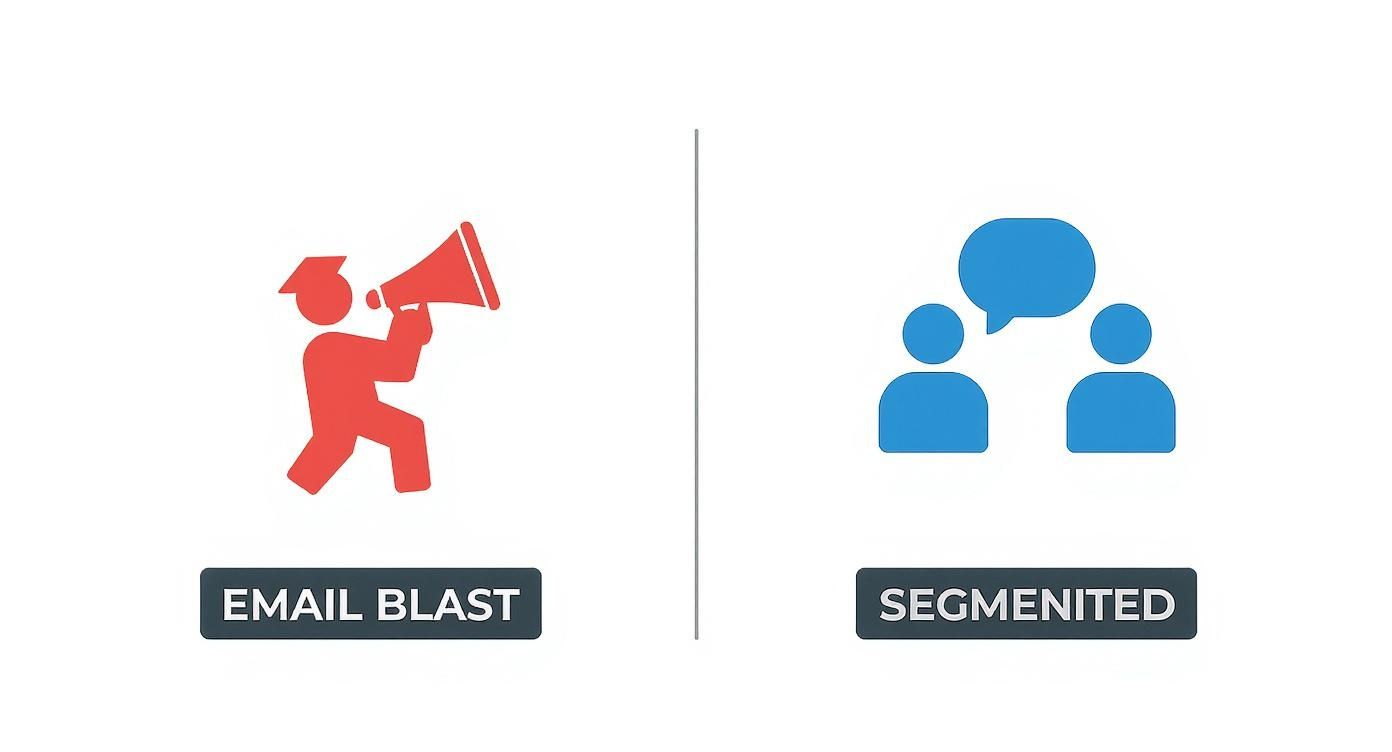
Think of it like this: an email blast is your megaphone. It’s perfect for shouting major news from the rooftops that everyone on your list needs to hear. A segmented campaign, on the other hand, is more like a quiet chat over a coffee, tailored to what you know a specific person cares about. Both have their place in your toolkit.
The Modern Role of Mass Emails
A smart e mail blast strategy always starts with a solid understanding of who you're talking to. Even when you’re sending a message to your entire list, you still need to identify your target audience to make sure the core message lands well. After all, you wouldn't "blast" an announcement for a new vegan menu to a list you know is full of dedicated steak lovers.
The trick is to save this approach for messages that genuinely have universal appeal.
Here are a few classic examples of when an e mail blast is the perfect choice:
- Announcing a massive, store-wide sale: A 30% discount on everything is great news for every single customer, no matter what they’ve bought before.
- Informing everyone about new opening hours: This is a critical update that your entire subscriber base needs to know.
- Sharing important company news: Things like a major policy change or an exciting company milestone are bits of information meant for everyone.
Here’s a quick guide to help you decide which approach to take for different situations.
Email Blast vs Segmented Campaign: When To Use Each
| Scenario | Best Choice | Why It Works |
|---|---|---|
| Announcing a 48-hour flash sale on all products | Email Blast | The offer is simple, urgent, and applies to everyone. Your goal is maximum reach, fast. |
| Welcoming a new subscriber to your list | Segmented Campaign | This is a one-to-one interaction. You want to make a personal first impression, not shout. |
| Promoting a new line of waterproof jackets | Segmented Campaign | Target customers who previously bought outdoor gear or live in areas with high rainfall. |
| Sharing your updated privacy policy | Email Blast | This is a legal and operational update that must be sent to your entire database. |
| Reminding a customer about items left in their cart | Segmented Campaign | This is highly personal. The message is triggered by an individual's specific actions. |
| Announcing your new holiday opening times | Email Blast | Like a privacy policy update, this is essential information for every single customer. |
Making the right choice between a broad blast and a targeted message ensures your emails are always relevant and welcome in your subscribers' inboxes.
The financial impact of email in the UK is massive, delivering one of the best returns on investment you can get. The data shows an average ROI between 3600% and 3800%, which means for every £1 a business spends, they can see a return of £36 to £38.
This proves that when used correctly, e mail blasts aren't just effective; they're a seriously profitable part of any small business marketing plan. The strategy isn’t dead—it has just become more specialised. By understanding when to shout and when to whisper, you can make every single email you send count.
Creating Your First E Mail Blast Step By Step
Sending your first email blast can seem like a big deal, but it’s really just a series of simple steps. Once you get the hang of it, you'll have a repeatable process you can use time and time again. This guide will walk you through building a campaign from the ground up, so you can feel confident hitting that 'send' button.
It all starts with one simple question: what do you want people to do when they open your email? Without a solid answer, your message will just get lost in the noise. Every good campaign is built on a clear, measurable goal.
Step 1: Define Your One Clear Goal
Before you write a single word, you need to know exactly what you're trying to achieve. Are you pushing traffic to a new blog post? Announcing a last-minute sale? Trying to get sign-ups for a webinar? If you try to do too much at once, you’ll just confuse your audience and they'll end up doing nothing.
Pick one main goal and make your entire email about that. This single-minded focus makes writing the copy, choosing the design, and crafting your call-to-action so much easier.
Here's how to do it:
- Start with an action verb: What do you want the user to do? (e.g., "Drive," "Increase," "Boost").
- State the specific outcome: What is the tangible result you're after? (e.g., "sales for a new product," "bookings for a service," "attendance at a webinar").
- Make it measurable: Can you track it? (e.g., Number of sales, booking confirmations, webinar sign-ups).
Practical Example:
- Vague Idea: "I want to tell people about my new product."
- Clear Goal: "Drive 50 sales of the new 'Sunrise Roast' coffee blend in the first 48 hours."
With your objective locked in, the next challenge is getting your email noticed in a crowded inbox.
Step 2: Craft an Irresistible Subject Line and Preview Text
Your subject line is your first (and sometimes only) impression. It has to be compelling enough to stand out and make someone want to click. The best ones are often short, descriptive, and create a little bit of urgency or curiosity.
Don't forget the preview text! That’s the little snippet of text you see next to the subject line in your inbox, and it's your secret weapon. Use it to back up your subject line and give another clue about the value waiting inside.
A Step-by-Step Guide to a Great Subject Line:
- State the Core Offer: Be direct. "25% Off Everything" or "Free Delivery This Weekend".
- Add Urgency: Use time-sensitive words. "Ends Tonight," "48-Hour Sale," "Last Chance".
- Inject Personality: Use an emoji or ask a question. "☀️ Ready for the sun?" or "Did you see this?".
- Write the Preview Text: Use this to expand on the offer. If the subject is "Our Biggest Sale Ever!", the preview text could be "Save up to 50% on selected lines."
This image really highlights the difference between a generic blast and a more targeted approach.
Even with a broad email blast, putting yourself in your reader's shoes is what makes the difference.
Step 3: Design and Write Your Email
Right, it’s time to actually build the email. The most effective email blasts are simple, clean, and easy to read – especially on a phone, where more than half of all emails are opened. For a deeper dive, it's worth learning how to write a marketing email that converts.
Keep your text short, sweet, and focused entirely on that one goal we talked about. Use short paragraphs, bullet points, and clear headings so people can scan it easily. Your call-to-action (CTA) button needs to be unmissable, with punchy, action-focused text like "Shop the Sale" or "Book Your Spot."
A Quick Implementation Guide:
- Choose a Single-Column Layout: This looks best on mobile devices.
- Place Your Logo at the Top: For instant brand recognition.
- Write a Clear Headline: It should mirror your subject line's promise.
- Keep Body Text to 2-3 Short Paragraphs: Get straight to the point.
- Use a Bold CTA Button: Make the button colour contrast with your background and use action-oriented text (e.g., "Get 25% Off" instead of "Click Here").
Tools like Astonish Email make this whole process a breeze. You can explore our full range of features that help small businesses build, send, and track stunning campaigns without needing any technical skills. By following these steps, you’ll be creating email blasts that not only reach your audience but actually get them to act.
How to Make Sure Your Emails Actually Reach the Inbox
Sending an email blast is one thing, but getting it to land in your customer's inbox is a whole different ball game. Think of it like posting a letter: you need the right address, a trusted stamp, and a good reputation with the post office to make sure it doesn’t get tossed in the bin. In the email world, this is called deliverability, and it's the absolute bedrock of a successful e mail blast.
When your emails end up in the spam folder, it’s usually because providers like Gmail or Outlook don’t trust the sender. This trust is what we call your sender reputation. It’s something you build up over time by consistently sending emails that people actually want to open. A poor reputation means your messages get filtered out before they ever have a chance to be seen.
The good news is that UK marketers are getting really good at this. In 2024, delivery rates hit a massive 98% across all sectors, which just goes to show that following best practices really pays off.
Step 1: Build Your Sender Reputation
To steer clear of that dreaded spam folder, you have to prove to the email gatekeepers (like Gmail and Outlook) that you’re a legitimate business. This comes down to a few key actions that build and protect your reputation.
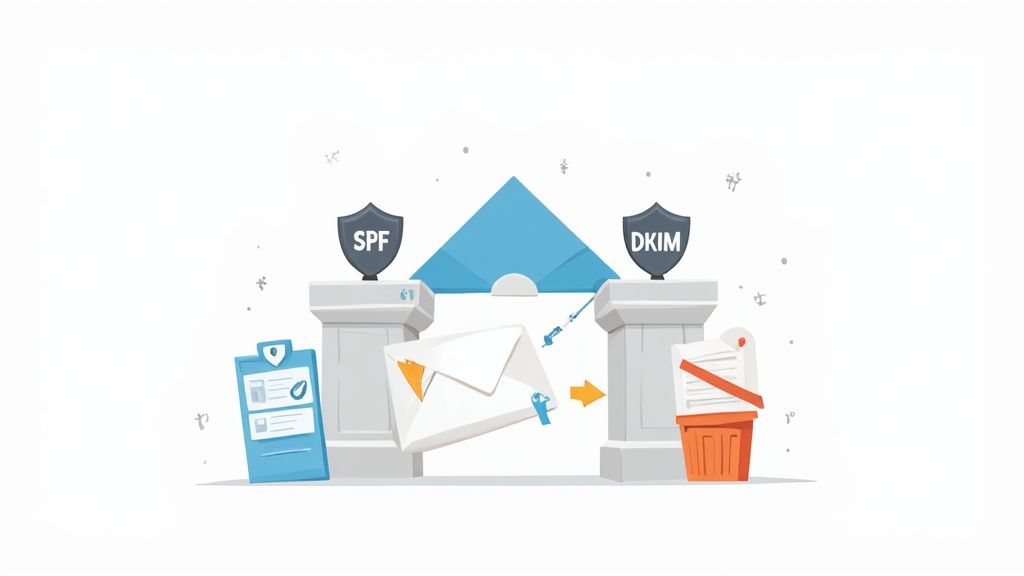
First up is email authentication. It sounds technical, but the concept is simple. By adding a couple of digital signatures (known as SPF and DKIM) to your domain, you're essentially verifying your identity. It's like showing your passport at the border—it proves to email providers that the message is really from you and not a scammer trying to impersonate your business. Most email marketing platforms guide you through this process, which usually involves adding a TXT record to your domain's DNS settings.
Next, you've got to keep your email list squeaky clean. Every time you send to an old or invalid address, it "bounces" back. Too many bounces and the email providers start to think you're not managing your list properly, which hurts your reputation.
A high bounce rate is one of the quickest ways to torpedo your sender reputation. Regularly cleaning your list by removing inactive subscribers and invalid addresses isn't just a nice-to-have; it's essential for good deliverability.
Step 2: Follow List Management Best Practices
A healthy list is an engaged list. Stick to these rules, and you'll keep your deliverability high and your messages where they belong: in the inbox.
Here is a practical, step-by-step guide to keeping your list healthy:
- Remove Bounced Emails Immediately: After each campaign, check your report for "hard bounces." These are invalid addresses. Most platforms, like Astonish Email, will automatically suppress these, but if not, delete them from your list immediately. A hard bounce means the address is permanently undeliverable.
- Honour Unsubscribes Instantly: Ensure your email platform processes unsubscribes in real-time. Never re-upload an old list that might contain people who have opted out. It's not just bad manners; it’s a one-way ticket to getting spam complaints, which will seriously damage your reputation.
- Run a Re-engagement Campaign: Once every 6 months, create a segment of subscribers who haven't opened your last 5-10 emails. Send them a specific campaign with a subject like "Is this goodbye?" or "Do you still want to hear from us?". Give them a clear option to stay subscribed; if they don't engage, remove them. This keeps your list full of people who actually want your emails.
Following these rules shows email providers you respect your audience and are a sender they can trust. That trust is what ensures your e mail blasts consistently reach the people who want to hear from you. For more detail, you can read about Astonish Email’s anti-spam policy and our commitment to responsible sending.
Navigating GDPR and UK Email Marketing Law
For any UK business sending out email blasts, getting to grips with email law isn't just a good idea—it's absolutely essential. It might sound like a dry, complex topic, but these rules are actually designed to help you build a far better, more trusting relationship with your customers.
The two big players you need to know are the General Data Protection Regulation (GDPR) and the Privacy and Electronic Communications Regulations (PECR). Think of them not as hurdles, but as a framework for respectful, effective marketing. The core idea is simple: you must have clear permission before you send someone a marketing email. Just buying a list and hoping for the best is a one-way ticket to a damaged reputation and potentially serious fines.
Step 1: Getting Explicit Consent Is Key
The bedrock of legal email marketing is what’s known as explicit consent, or an "opt-in." This means someone has to take a clear, positive action to say, "Yes, please send me your marketing emails." Those sneaky pre-ticked boxes on sign-up forms? They're a thing of the past and a definite no-go.
Here’s a step-by-step guide to creating a compliant sign-up form:
- Add an Unticked Checkbox: Ensure the box for marketing consent is empty by default. The user must physically click it to opt in.
- Use Clear Language: Write exactly what they are signing up for. Bad Example: "Tick to agree to our T&Cs." Good Example: "Yes, I'd love to receive weekly offers and news from [Your Brand Name] via email."
- Provide a Link to Your Privacy Policy: Place a clear link directly under the consent statement so users can easily see how you will handle their data.
- Keep Records: Your email marketing platform should automatically record the time, date, and source of the consent for every subscriber. This is your proof of compliance.
Under GDPR, consent must be "freely given, specific, informed, and unambiguous." This means you can't just bury email consent inside your general terms and conditions. It needs to be a separate, crystal-clear choice.
Step 2: Providing an Easy Way Out
Just as crucial as getting permission is making it easy for someone to change their mind. Every single marketing email you send must have a clear and simple way for people to unsubscribe. Hiding the link in tiny grey font at the bottom or making them log in and solve a puzzle to opt out is against the rules and, frankly, just bad practice.
How to Implement a Compliant Unsubscribe Process:
- Include a Clear Link: Every email footer must have a visible link with text like "Unsubscribe" or "Manage your preferences."
- Make it One-Click: The best practice is for the unsubscribe process to be completed in one or two clicks. The user should not have to log in or enter their email address again.
- Process it Instantly: The request must be honoured immediately and automatically by your email service provider.
Ultimately, these regulations guide you towards better marketing. When you build a list of people who have genuinely asked to hear from you, your email blasts land in front of a much more engaged audience. And that always leads to better results.
For a detailed look at how we handle data, you can read more about Astonish Email’s privacy policy and see our commitment to protecting user information.
Measuring the Success of Your E Mail Blasts
Sending an email blast is only half the story. The real work begins after you hit send, because you need to understand what happened next. To figure out if your campaign actually landed well, you have to dig into the data.
Think of your email report as a conversation with your audience. Every metric—opens, clicks, unsubscribes—is a piece of feedback telling you exactly what they thought.
Learning to interpret this feedback is what separates a one-hit-wonder from a consistently successful email strategy. It’s about moving beyond just glancing at the numbers and starting to ask, "What is this telling me about my business and my customers?"
Your Core Email Marketing Metrics
To get a clear picture of performance, you need to focus on a handful of essential metrics. Each one gives you a different clue about what worked and where you can get better.
- Open Rate: This is simply the percentage of people who opened your email. It’s your first big hurdle and the most direct feedback on your subject line.
- Click-Through Rate (CTR): The CTR tells you what percentage of people who opened your email went on to click a link inside it. This is where you find out if your message and your offer were truly compelling.
- Conversion Rate: This is the ultimate goal. The conversion rate tracks how many people actually completed the action you wanted them to take after clicking, whether that was buying a product or filling out a form.
- Unsubscribe Rate: This shows you how many people decided to opt out. A few unsubscribes are perfectly normal, but a sudden jump is a massive red flag that your content is missing the mark.
To give you a bit of context, recent UK benchmarks show average open rates hovering around 37.93%, with click rates at 1.29%. While the average conversion rate for an email blast is about 0.08%, the top-performing campaigns can hit 0.44%—that's more than five times higher. You can dig deeper into these numbers and find more UK email marketing performance insights to see how you stack up.
Key E Mail Blast Metrics and How to Improve Them
Understanding your key performance indicators (KPIs) is the first step. The next is knowing what to do with them. This table breaks down the essentials and gives you a practical starting point for making improvements.
| Metric (KPI) | What It Measures | One Practical Step To Improve It |
|---|---|---|
| Open Rate | The percentage of recipients who opened your email. | Run an A/B Test: In your next campaign, write two different subject lines. Send version A to 10% of your list and version B to another 10%. After an hour, send the winning version to the remaining 80%. |
| Click-Through Rate | The percentage of openers who clicked on a link. | Improve Your CTA Button: Change the button text from a passive "Learn More" to an active "Shop the Sale Now". Also, ensure the button's colour contrasts sharply with the email's background. |
| Conversion Rate | The percentage of clickers who completed your goal. | Align Your Landing Page: Make sure the headline and main image on the page people land on after clicking perfectly match the promise you made in the email. Consistency builds trust and reduces drop-offs. |
| Unsubscribe Rate | The percentage of recipients who opted out. | Review Your Sending Frequency: If the rate spikes, you might be sending too often. Try reducing your sends from weekly to fortnightly for a month and see if the rate drops. |
| Bounce Rate | The percentage of emails that couldn't be delivered. | Implement a List Cleaning Schedule: Set a calendar reminder every three months to perform a list hygiene check, removing unengaged subscribers and any addresses that have hard bounced. |
Don't let these numbers intimidate you. Each one is just a signpost pointing you toward a better, more effective email strategy.
Turning Data into Action
The real magic happens when you use this data to make smarter decisions next time. Don't just look at the metrics as a final score; see them as your playbook for improvement.
A Step-by-Step Example of Using Data:
- Observation: Your last campaign had a great Open Rate (40%) but a very low Click-Through Rate (0.5%).
- Diagnosis: This tells you the subject line was fantastic and got people's attention, but the content inside the email didn't convince them to act.
- Hypothesis: The call-to-action button was unclear, or the offer wasn't compelling enough.
- Action for Next Time: For your next email, you will use a much bolder, more prominent CTA button and make the discount or offer the main focus of the email copy.
By making these small, data-informed tweaks, you can make a huge difference to the performance of your next email blast.
Simple Email Blast Examples for UK Businesses
The best way to get a feel for email blasts is to see them in action. To get you started, let's look at three classic templates you can adapt for your own business. They cover some of the most common situations a UK small business might face.
Each example has a clear subject line to catch the eye, some simple body copy to get the message across, and a strong call-to-action that tells people exactly what to do next.
1. Announcing a Seasonal Sale
This is the bread and butter of email marketing. It’s a straightforward, effective way to drive sales and create a bit of urgency. Think Bank Holidays, Black Friday, or the start of a new season.
- Subject Line: ☀️ It’s Here! Our Summer Bank Holiday Sale Starts Now
- Body Copy: Hi [Name], get ready for the long weekend with 25% off everything in our Summer Collection! From garden furniture to BBQ essentials, find everything you need to make the most of the sunshine. This offer ends Monday at midnight, so don't miss out.
- Call-to-Action: Shop the Sale
2. Inviting Locals to an In-Store Event
Got a physical shop? An email blast is a brilliant way to invite your local community to an event, whether it's a workshop, a tasting, or a special late-night opening. It makes sure everyone on your list knows what’s happening and when.
- Subject Line: You're Invited! Join Us for Our Christmas Shopping Evening
- Body Copy: Hello! We're kicking off the festive season with an exclusive shopping evening at our high street shop on Thursday, 30th November. Enjoy a glass of mulled wine, mince pies, and a first look at our new Christmas gifts. We can't wait to see you there!
- Call-to-Action: Get the Details
3. Launching a Brand New Product
When you’ve got something new and exciting to share, you want to shout about it from the rooftops. A product launch email builds anticipation and funnels all that interest straight to your website.
- Subject Line: 🎉 Introducing the New Artisan Coffee Blend!
- Body Copy: The wait is over! We are so excited to introduce our brand new 'Sunrise Roast' coffee blend. Sourced from the finest beans and roasted right here in Manchester, it’s the perfect way to start your day. Be among the first to try it.
- Call-to-Action: Order Yours Today
Pro Tip: These templates are a fantastic launchpad, but remember that the best emails feel personal. Something as simple as using your subscriber's first name can instantly make a mass email feel more like a friendly chat.
Tools like Astonish Email make this incredibly easy. With drag-and-drop builders and ready-made templates, you can put together a professional-looking email blast in minutes, without any technical headaches.
Got Questions About Email Blasts? We’ve Got Answers.
When you're just dipping your toes into email marketing, a few questions always pop up. Let's tackle some of the most common ones we hear from small business owners across the UK.
How Often Should I Be Sending Emails?
There isn't a one-size-fits-all answer here; it really comes down to your business and what your subscribers signed up for. The best advice I can give is to only hit 'send' when you have something genuinely useful or interesting to say.
A Practical Step-by-Step Guide to Finding Your Frequency:
- Start Conservatively: Begin by sending one email every two weeks. This is frequent enough to stay top-of-mind without being annoying.
- Monitor Your Metrics: After a month, look at your unsubscribe and open rates. If unsubscribes are very low and opens are high, you may have room to increase frequency.
- Test an Increase: Try sending weekly for one month and watch the metrics closely. If engagement drops or unsubscribes spike, you've found your limit. Pull back to your previous schedule.
- Ask Your Audience: Consider sending a one-question survey asking subscribers how often they'd like to hear from you (e.g., weekly, monthly).
Is There a 'Best' Time and Day to Send?
While your own audience will have its unique habits, decades of email marketing data have revealed some pretty clear patterns. Generally, the sweet spot tends to be mid-week and mid-morning.
Tuesday at 10 AM is often hailed as the prime time to send. By then, most people have cleared their urgent Monday morning backlog but aren't yet swamped by the day's tasks, so they're more receptive to checking their personal inbox.
How to Find Your Best Time:
- Start with the Benchmark: Send your first few campaigns at the industry-standard time (e.g., Tuesday at 10 AM).
- Split Your List: For your next campaign, send it to half your list on Tuesday at 10 AM and the other half on Thursday at 2 PM.
- Compare the Results: After 24 hours, check which send time got the higher open and click-through rates.
- Repeat and Refine: Continue testing different days and times until you find a consistent winner for your specific audience. Your email platform's reporting will be your best friend here.
Can I Just Buy an Email List to Get Started in the UK?
Let me be crystal clear on this one: absolutely not. Under UK GDPR rules, you need explicit, freely-given consent to send marketing emails to someone. A purchased list, by its very nature, fails this test.
Sending emails to a list you bought isn't just illegal; it's a fast track to getting your domain blacklisted by email providers. This tanks your "sender reputation," meaning even your legitimate emails to real customers could end up in the spam folder. Always, always build your list organically. It takes longer, but it's the only way to build a real relationship with your audience.
Ready to create email blasts that actually get results? Astonish Email gives UK small businesses all the tools to build, send, and track beautiful campaigns in minutes. Start your free plan today and see how easy it is.